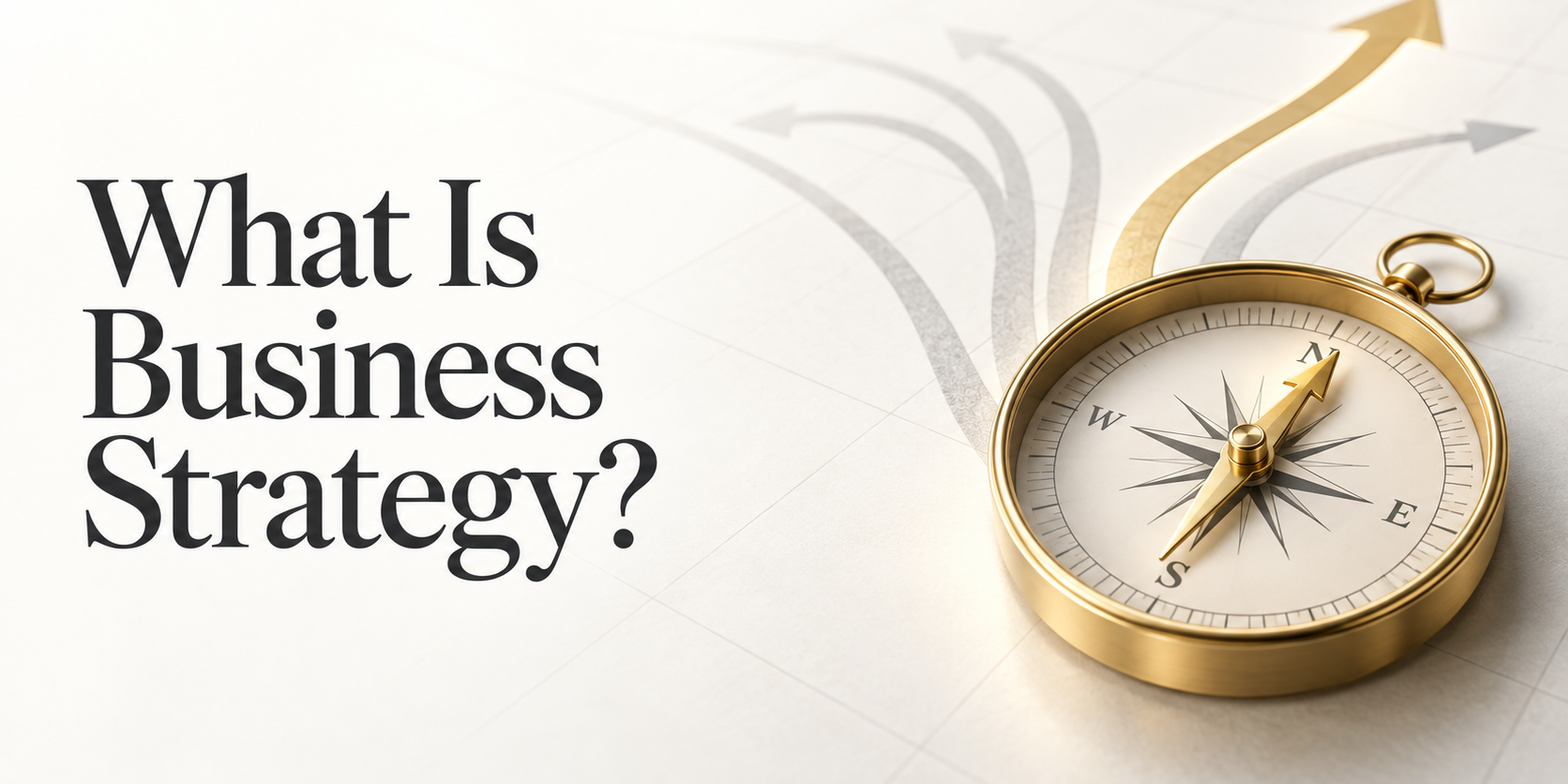
Business strategy is the long-term direction a company chooses to achieve its goals and create a strong position in the market.
It answers several fundamental questions:
- Where is the business going?
- Which customers will it serve?
- What value will it provide?
- How will it compete?
- What will it prioritise?
- What will it choose not to do?
A strong business strategy gives leaders a framework for making decisions. It helps a company focus its time, people and resources on the opportunities that are most likely to support sustainable growth.
Without that clarity, a business may still be busy, but its activity can become fragmented. Teams may pursue different priorities, marketing may communicate an unclear message and investment decisions may be made without a shared understanding of the company’s direction.
Business Strategy Is More Than a List of Goals
Goals describe what a business wants to achieve. Strategy explains how it intends to achieve it.
For example, a company may set a goal to increase revenue by 20 per cent. That is an objective, not a strategy.
The strategy might be to specialise in a more profitable market segment, introduce a recurring service, strengthen customer retention or expand into a new region. Each option requires different resources, capabilities and marketing decisions.
A useful strategy connects ambition with choice. It identifies the route the business will follow and the trade-offs it is prepared to make.
The Core Elements of a Business Strategy
Although every organisation is different, an effective business strategy usually includes the following elements.
A clear vision
The vision defines what the business is working towards. It should be specific enough to guide decisions while allowing the company to adapt as circumstances change.
A defined market
The business needs to understand who it serves and where it intends to compete. Trying to appeal to everyone often leads to weak positioning and unfocused marketing.
A strong value proposition
Why should a customer choose this business? The answer may involve specialist expertise, convenience, service quality, price, innovation or a distinctive customer experience.
Competitive advantage
A business strategy should explain what the organisation can do particularly well and why that advantage will be difficult for competitors to copy.
Priorities and resource allocation
Strategy requires decisions about where to invest money, time and talent. It also requires leaders to identify activities that no longer support the direction of the business.
Measures of progress
The strategy should be supported by meaningful performance indicators. These allow leaders to see whether the business is moving in the right direction and where adjustments may be needed.
Why Business Strategy Matters to Marketing
Marketing cannot create lasting results when it is disconnected from the wider business strategy.
If the company wants to become the leading specialist in a particular niche, its content, website, search visibility and sales messages should reinforce that expertise. If the priority is customer retention, the marketing plan may place greater emphasis on communication, education, service experience and referral development.
The business strategy gives marketing its context. It determines which audiences matter, which offers should be promoted and what the company needs to be known for.
Questions to Ask About Your Current Strategy
Business owners and leadership teams should be able to answer the following questions clearly:
- What are our most important goals over the next three years?
- Which customers are the best fit for our business?
- What problem do we solve better than our competitors?
- Which services or products are most important to our future?
- Where should we invest more?
- What should we stop doing?
- How will we know whether the strategy is working?
If the answers vary significantly across the leadership team, the strategy may need further clarification.
Strategy Creates Focus
A good business strategy does not remove uncertainty. It gives the organisation a clear way to respond to it.
Markets change. Technology develops. Customer expectations evolve. New competitors emerge. A clear strategy helps leaders assess those changes without chasing every new idea or reacting to every short-term pressure.
The most effective strategy is one that people understand, use and revisit. It should influence everyday decisions, not sit untouched in a planning document.
At Strategic Results Marketing, we help businesses connect their goals, positioning and marketing activity so that every campaign supports a clearer commercial direction. If your marketing feels busy but disconnected, it may be time to return to the business strategy behind it.
Related Resources
- What Is Marketing Strategy? – Learn how marketing activity should support the wider direction of the business.
- What Is Strategic Planning? – Explore how long-term objectives are translated into priorities and action.
- What Is Competitive Advantage? – Understand how a business creates a meaningful reason for customers to choose it.
- What Are KPIs (Key Performance Indicators)? – Discover how to measure progress towards the outcomes that matter.